
Hypnotherapy to support those with Trauma, PTSD & C-PTSD
Understanding PTSD & C-PTSD
Post Traumatic Stress Disorder (PTSD) and Complex PTSD (C-PTSD) are not signs of weakness. They are your mind and body's natural response to events that felt overwhelming or unsafe.
PTSD often develops after a single traumatic incident, which could be an accident, war or exposure to violence (such as in the military or police force), physical or sexual assault, sudden loss or natural disaster.
C-PTSD results from repeated or ongoing trauma over time, such as neglect, physical, emotional and/or sexual abuse, or unsafe caregiving environments.
Trauma doesn't just live in the past.
It lives in the body.
You might know logically that you're safe now, but your nervous system and subconscious parts may still be stuck in survival mode. This can effect your sleep, mood, digestion, hormones, and your ability to feel calm and connected.
Signs you might be living with PTSD or C-PTSD
Not everyone experiences flashbacks. Common indicators can also include:
Anxiety, panic or hypervigilance
Avoidance, withdrawal or emotional numbness
Anger outbursts or blackout rage
Difficulty concentrating or feeling present
Chronic pain, tension, or health issues
Self destructive behaviours (e.g. substance use, reckless choices)
Feeling disconnected from yourself or others
Low sex-drive
Nightmares or difficulty sleeping (or sleeping too much)
Shame, guilt, or low self worth
Daily life struggles with work, relationships, social activities or maintaining your wellbeing


The Vicious Cycle
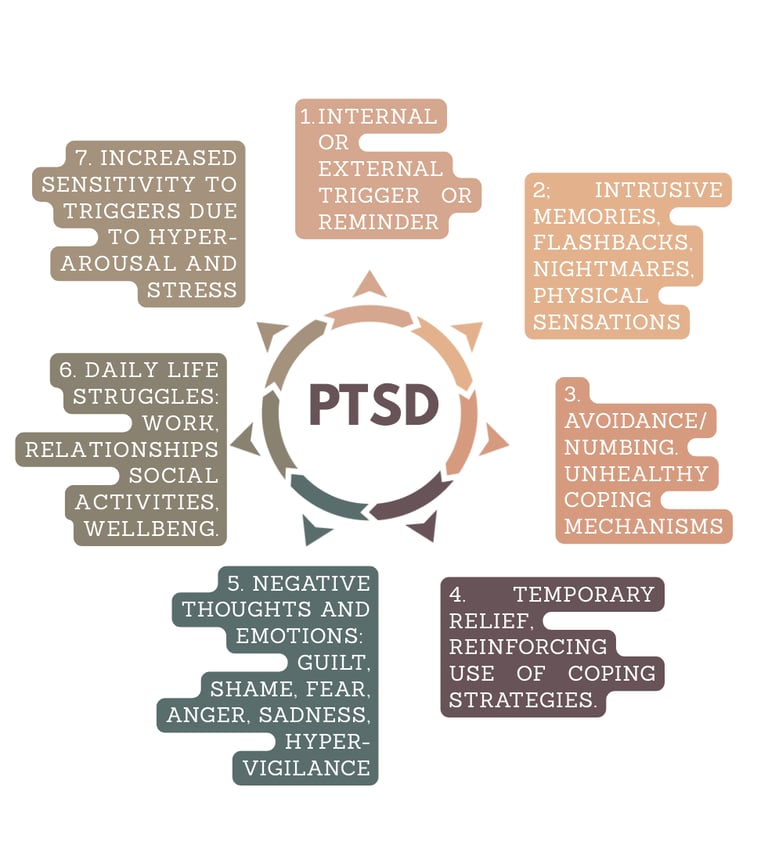
Trauma creates a loop and without addressing the root (the subconscious survival patterns), this cycle repeats:
1. Trigger: something reminds your nervous system of the past (often without you realising).
2. Body Reaction: anxiety, flashbacks, nightmares, pain, tension.
3. Coping Response: avoidance, numbing, overworking, substances.
4. Temporary Relief: your brain thinks the coping worked.
5. Negative Emotions: guilt, shame, anger, sadness.
6. Life Impact: strained relationships, poor sleep, health issues.
7. Increased Sensitivity: your system becomes even more reactive.
How and Why does PTSD and C-PTSD develop?
When you go through something overwhelming, your mind and body automatically shift into survival mode: fight, flight, freeze, or fawn.
In that moment, certain protective parts of you may “split off” to handle the shock, fear, or pain.
If these parts don’t get the chance to fully process what happened, they can remain stuck in survival mode. Over time, this can develop into PTSD or C-PTSD.
These parts live deep in the subconscious (what Freud called the Id ). When something in the present reminds them of the past (even in subtle ways) they can send a surge of intense feelings up into the Self : anger, shutdown, panic, relentless self-criticism.
If the trigger feels too big or too ignored, these parts may try even harder to be heard, sometimes showing up as panic attacks, rage, depression, insomnia, or withdrawal. Not to punish you, but to protect you - and to get your attention!
It’s important to know: these parts are not bad. They were doing what they thought was necessary to keep you safe. With the right support, they can begin to update their role, stand down from constant guard duty, and move toward a more natural, healthy state.
Let me further explain...
Think of your mind like an Iceberg.
The small part above water is your conscious mind (logic, willpower, reasoning).
Beneath the surface lies the subconscious mind - where protective parts, stored emotions, and survival instincts live.
The conscious mind might know you're safe now, but your subconscious parts can still be reacting as if the threat is happening today. That's why you can't just "think your way" out of trauma responses.
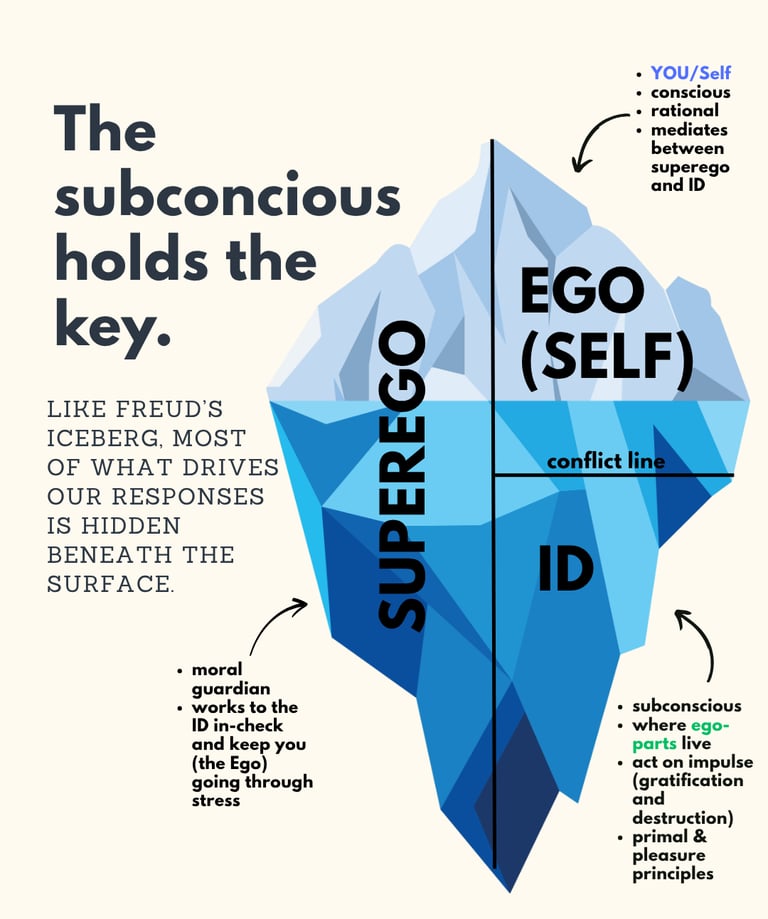
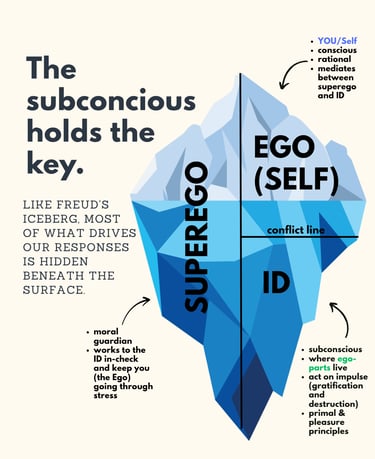
Freud’s Iceberg Model
Freud imagined the mind as an iceberg, most of it hidden beneath the surface.
Superego (above the waterline & below)
Your moral compass. It holds values, rules, and the sense of “what’s right.” It keeps the Id in check and pushes you to meet social and personal standards.
Ego / Self (partly above, partly below)
The mediator. This is the part of you that makes decisions, balancing the demands of the Superego and the Id. It’s the rational “you” that tries to navigate between impulse and rules.
ID (deep below the surface)
The instinctive, emotional part of your mind. It runs on survival drives, pleasure, and avoidance of pain. This is where many protective parts live - formed in moments of fear, hurt, or need.
In the iceberg model, there’s a point just below the surface where your conscious mind meets your subconscious mind.
This is often called the conflict line.
Above the line is your Ego/Self, the part of you that’s rational, logical, and trying to make day-to-day decisions.
Below the line are the protective parts in the Id, along with stored emotions and survival instincts.
When these deeper parts believe you’re in danger - even if you’re not - they send strong feelings and urges up toward the Self.
The Self might want one thing (“I know I’m safe, I want to do this”), while a protective part is pulling hard in the other direction (“It’s not safe, we can’t do that”).
This push-and-pull is the conflict, and it’s exhausting.
^Figure Above: depiction of Freuds Iceberg
Why do some people develop PTSD/C-PTSD and others don't?
It’s got nothing to do with being weaker or "too sensitive", it’s about the load you’ve been carrying.
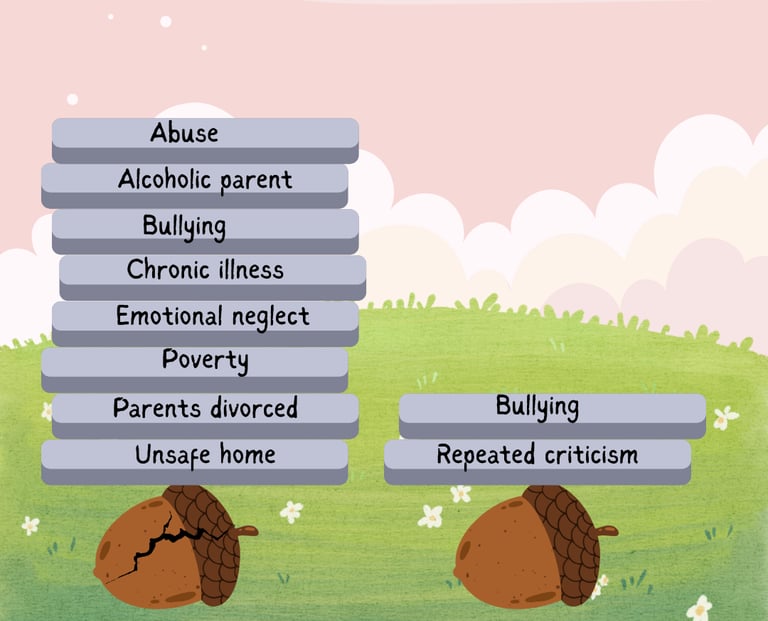
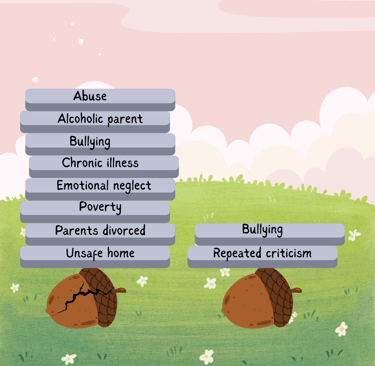
Sarah Yuen, my fantastic tutor from The Beat Retreat, shared an excellent analogy with me. Imagine our mind as an acorn.
Some acorns sit in the open with no paving slabs on top, or maybe just one or two. Others have many slabs stacked on them - each one representing a life difficulty such as losing a parent, being abused, experiencing neglect, bullying, or other hardships.
When a new traumatic event happens, the acorn with no slabs may be able to withstand the impact. But the acorn with ten slabs already in place is far more likely to crack - not because it’s weaker, but because it’s been carrying a heavier weight for much longer.
PTSD and C-PTSD are not signs of weakness. They are natural responses when the weight becomes too great. My work is not about erasing the past, but instead easing the pressure of what you've been holding onto, and supporting the mind and body to integrate experiences so the weight of the past can begin to feel less overwhelming.
Why and How Hypnotherapy works...
Most talk-based approaches work mainly at the conscious level, but trauma is often stored beneath the surface. Hypnotherapy bridges that gap and facilitates a safe, deeply relaxed container, allowing your conscious mind (Ego/Self) to communicate directly with your subconscious mind (Id) - the part that stores protective parts, emotions, and trauma responses.
In this state, when our focus is directed inwards, we can:
Build Trust -We meet each protective part with compassion, letting it know it’s heard, understood, and safe to share its story.
Discover the Role - We explore what that part has been trying to protect you from, and how it learned its strategies.
Update Its Reality - Through gentle, guided techniques, we help the part recognise that you have new resources, choices, and safety now.
Transform Its Role - Parts can shift into healthier states - becoming supportive, confident, creative, or nurturing
This work isn't about erasing memories or "fixing you".
A lot of people worry (or hope) that hypnotherapy will make them forget things or “delete” parts of themselves. That’s not what this work is about.
Your protective parts, even the ones that feel overwhelming right now, are not the enemy. They were created for a reason, and they’ve been working hard to keep you safe.
Our goal is not to get rid of them, but to help them update their role so they can support you in healthier ways.
Why they need to be heard...
When something traumatic happens, those parts often don’t get the chance to finish processing the experience.
They may still be carrying the fear, shame, or grief from that moment, as if it’s happening right now.
In hypnotherapy, we:
Give these parts the time, space, and safety to tell their story
Re-evaluate what happened from today’s perspective
Support them in completing the processing they couldn’t finish at the time
Show them that you have the resources and safety now to handle life differently
When every part of you feels heard and understood, your system can begin to stand down from survival mode - creating space for a life that’s more peaceful, present. This can support you to:
Feel safer in the present, so you’re not constantly on high alert
Respond with choice, instead of reacting on autopilot
Integrate your experiences, so the past no longer dominates daily life
Soften triggers, making them easier to navigate with compassion
Reconnect with your natural state - calmer, more resilient, and open to joy
So the memories remain, but they may no longer feel as dominant or controlling in how you live and feel.
I would be honoured to hold a safe space for you.
From the moment I decided to become a hypnotherapist, I knew I wanted to support people affected by trauma.
My goal is to create a safe container where your system can soften, explore, and reconnect at its own pace.
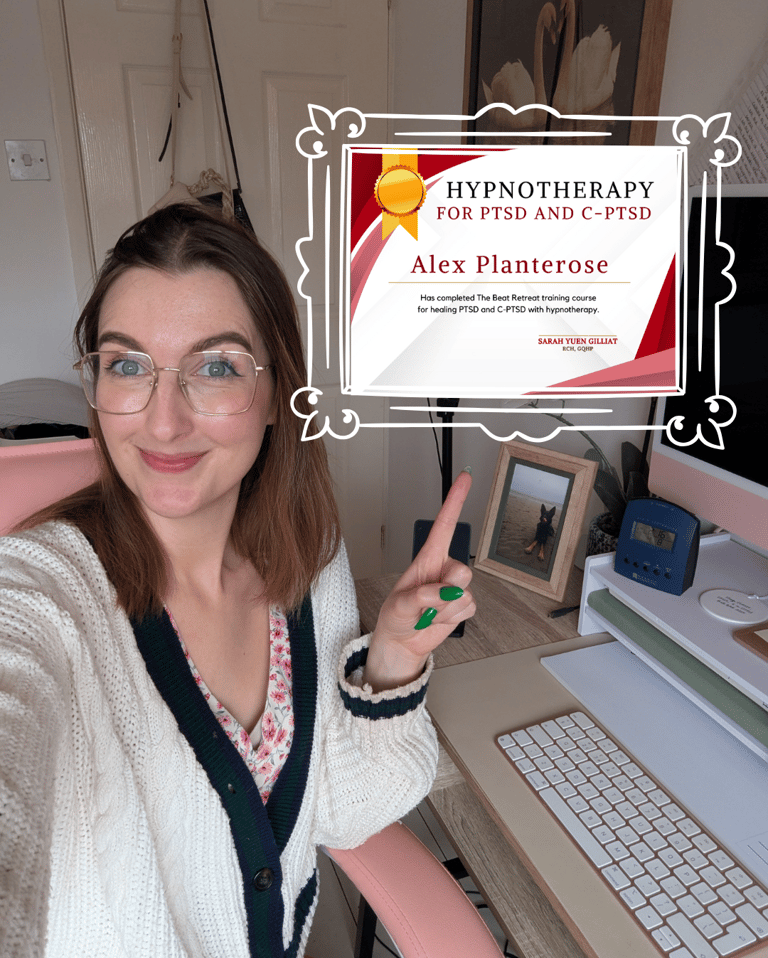
That commitment has guided every step of my training - and now, as a graduate of The Beat Retreat Hypnotherapy training for supporting individuals with PTSD and C-PTSD related symptoms, and soon listed on the CATCH (Crisis and Trauma Clinical Hypnotherapy) programme, I’m able to offer trauma-informed hypnotherapy to clients worldwide.
The Unburden Package
£600.00
1 x Initial Consultation (1.5hrs)
6 x Hypnotherapy sessions (1.5-2hrs)
This work feels deeply important to me because I know how life-changing it can be. PTSD, C-PTSD, and trauma don’t just live in the mind; they live in the body, the emotions, and the subconscious. And sometimes, talking about your trauma over and over brings little relief. Only you truly know what you experienced, how it felt, and what it has meant for your life.
I believe that You are your own expert. You already hold the wisdom and capacity for your own healing. My role is simply to help you access it, gently and safely.
There are parts within you - protective, resilient, and wise - just waiting for the chance to be heard and freed.
That’s why gently and curiously exploring your subconscious can be so powerful. In this space, real change can feel natural, safe, and deeply liberating.
If you’d like to explore this work together, you can book a free connection call to learn more about my bespoke hypnotherapy packages, including
The Unburden Package : A gentle, structured approach to support in you releasing the weight of the past and begin to feel safer in your body again.
If you’ve been living with the effects of Trauma, PTSD or C-PTSD, you’ll know how exhausting it is to carry that constant weight: the hyper-vigilance, the shutdowns, the sleepless nights, the emotional swings.
It can feel like no matter how much you understand logically that you’re safe now, something deeper keeps pulling you back into survival mode.
The Unburden Package is created specifically to support this kind of inner work, at the pace your nervous system feels ready for.
It brings together trauma-informed hypnotherapy and parts work to help you:
Gently meet and listen to the protective parts of you
Re-evaluate what they’ve been holding onto
Support them in completing the processing they couldn’t finish at the time
Support your system in cultivating a sense of calm, safety, and choice in daily life
Rather than forcing change, we work with your whole system - mind, body, and emotions - so that any shifts that emerge feel safe, sustainable, and genuinely your own.
A deeply supportive journey for those experiencing PTSD, C-PTSD or trauma-related symptoms. Designed to help you gently process and work with trauma responses and unresolved experiences, which supports you to feel grounded, safe, and free to move forward with confidence, clarity and self-trust.
This package supports you to:
• Process and work with trauma responses and unresolved experiences
• Connect with and bring relief to the parts of you that have been carrying heavy emotions
Strengthen your inner foundation and support a growing sense of safety within yourself
• Feel safe to be seen and fully expressed in your life and work
Includes:
• 1 in-depth initial consultation to explore your story, history, and goals in a safe, supportive way.
• A gentle hypnotherapy introduction - perfect for sensitive souls or those with trauma to feel safe and encouraged before going deeper.
• 6 personalised Hypnotherapy sessions combining the Sarah Yuen PTSD protocol with subconscious work and practical tools
• Email and WhatsApp check-ins throughout your journey, so each session can be tailored to meet you exactly where you are
• A selection of personalised hypnosis recordings to support your ongoing growth and wellbeing.
If this resonates, you're warmly invited to work with me.
Through Hypnotherapy, let this be the beginning of the journey of coming home to yourself.

